According to data from Airports Council International (ACI) World, overall global passenger volumes continue to climb to unprecedented levels. Airport traffic reached an estimated 10 billion passengers in 2025, up 3.7% from the prior year and 6.5% from pre-pandemic 2019 levels. And volumes aren’t expected to slow down anytime soon.
That said, airport infrastructure faces increased pressure to expand capacity while maintaining the high level of service passengers have grown accustomed to. However, in most airports, discussions focus on the facility’s ability to increase throughput and scale immediately, rather than the long-term implications of infrastructure upkeep for sustained success.
Instead, airports should prepare for operational resilience and future-proof their facilities through a balanced tri-pillar strategy that integrates capacity, flexibility and maintainability from the earliest planning stages. Read on to learn why this strategy matters for airports in today’s high-demand environment.
The Pillars of Modern Airport Design Infrastructure
High-throughput systems are necessary and valuable, but if they can’t be easily serviced and are offline for several hours a day or several days a week, the investment becomes counterproductive. It underscores the importance of the three-legged stool of planning for capacity, flexibility and maintainability. Here’s more about these three pillars of modern airport design infrastructure:
Capacity
Airports need to have both the physical and digital capacity to handle passenger volumes. Traditionally, airports focused most of their efforts on expanding the physical footprint, which consisted of building larger terminals, adding gates and implementing high-speed baggage handling conveyors and networks. However, the physical footprint often doesn’t account for operational efficiency and system uptime.
Flexibility
Airports need to be flexible enough to adapt to changing passenger demographics, seasonal demands and shifting regulatory frameworks. These facilities have historically achieved flexibility by designing more open-space terminals and gates that can handle both domestic and international flights. However, adaptive spaces are only useful if the integrated technology can scale with them.
Maintainability
Maintainability is a practical measure of how quickly and effectively infrastructure can be inspected, serviced, repaired and returned to operation. It depends on more than the equipment itself: modular components, clear access, diagnostic capability, skilled teams, spare-parts availability and workable intervention windows all matter. These factors make maintainability the operational anchor that turns capacity and flexibility into sustained performance.
Why Maintainability is the Driver of Operational Resilience
In many airports, the main focus is on throughput. In reality, maintainability is just as important. It all goes back to the example that we shared in the previous section: Your systems and technology are only valuable if they are online and operating. Failing to maintain systems easily will eventually lead to unplanned downtime, which can create bottlenecks and delays and impact the passenger experience as volumes continue to surge.
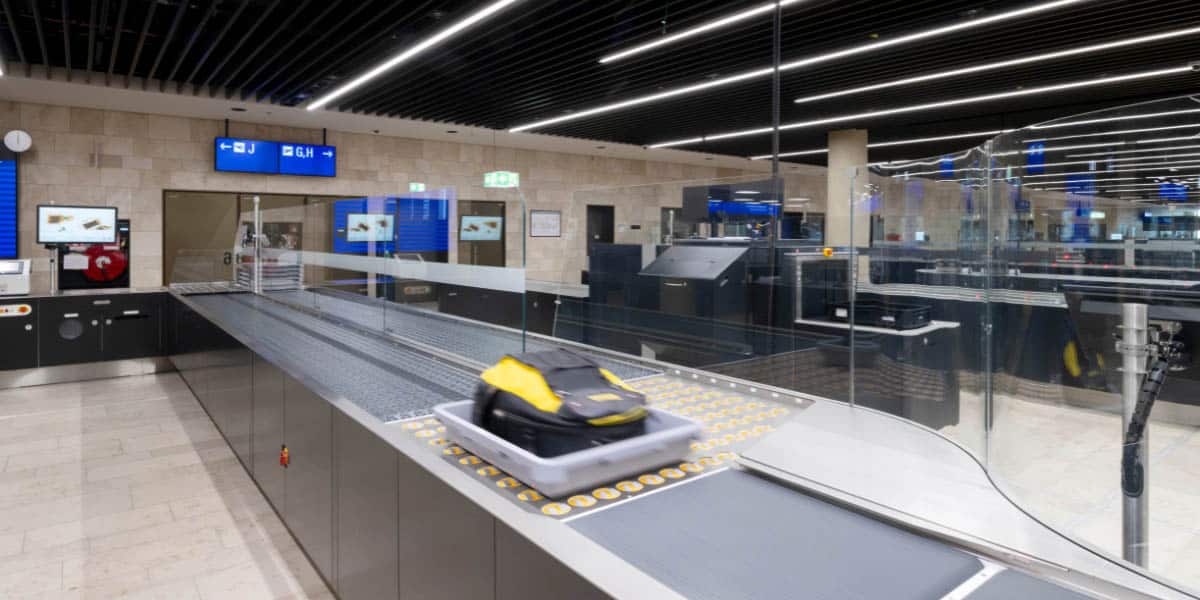
This is particularly visible in high-throughput security lanes. Their value is not only their theoretical processing rate, but how consistently that rate can be delivered across the operating day. Designing for access, fast fault isolation and controlled replacement of components helps operators recover capacity without creating unnecessary disruption.
The mean time to repair, or MTTR, is the average time that’s needed to troubleshoot, fix and restore a failed system or piece of equipment. It’s a metric that helps airports measure equipment reliability and track how well they handle breakdowns. MTTR is calculated by dividing total maintenance time by the total number of repairs. A lower MTTR is better and indicates a team that identifies and fixes problems quickly to keep systems moving. A high MTTR, conversely, can significantly reduce efficiency.
Any time a security lane goes down, it creates an instantaneous bottleneck. Airports experience an immediate loss of processing capacity and lines increase. During peak passenger times, a snowball effect may take place. Security professionals may be reassigned to manage crowds, reroute passengers or perform manual screening. Prolonged delays don’t just strain an airport; they also negatively impact the customer experience. Passengers may miss flights and connections, and the airport itself may become more chaotic and unsatisfactory.
Technology and advanced equipment are necessary in the modern-day airport. However, just as important is the ability to access and maintain these systems so they work for — not against — you.
Strategies for Creating Future-Ready Airport Facilities
So how can you design a future-ready airport that can scale its capacity, remains flexible and can be easily maintained? Here’s a look:
Invest in Modular Design
The plug-and-play framework applies to many applications, including airports. Invest in solutions with easily swappable sub-assemblies that can quickly isolate failures or issues, with parts and components that can be removed and replaced quickly. Modular structures and technology enable seamless refreshes without intensive, invasive repairs.
Always Have Spare Parts Handy
Fast restoration depends on more than holding a large inventory. Airports should define critical spares using the installed base, failure impact, lead times and planned maintenance requirements. Keeping the right parts visible, controlled and close enough to the point of use can reduce repair time while avoiding unnecessary stock.
Adopt Proactive and Predictive Maintenance Practices
A data-driven maintenance approach combines preventive tasks with condition monitoring and operational insight. Fixed maintenance intervals remain important, but they should be complemented by information that helps teams identify deterioration before it becomes a disruption. Planning interventions in agreed operational windows is equally important: maintenance must protect availability, not merely be scheduled around it.
How Technology Providers and Airport Operators Can Work Together
Technology providers and airport operators have historically had a transactional relationship in which vendors sell the hardware and airport operators take responsibility for running it. To achieve the best results, the ideal situation is for technology providers and operators to form a true partnership that extends from design through equipment decommissioning. By forming this partnership, the two parties are better able to:
- Co-design for real-world problems that airport facilities may face. Technology providers can receive direct feedback from the airport personnel who know their daily challenges and where improvements can be made.
- Coordinate jointly on innovation and solution deployment.
- Help ensure that the systems they adopt in their facilities meet the necessary capacity, flexibility and maintenance requirements.
At Daifuku Airport Netherlands, we apply this life-cycle perspective by working with airports on solutions that are scalable, serviceable and workable in live operations. The focus is not only on what a system can process, but on how it can be maintained, adapted and returned to service throughout its life.
Conclusion
Airports continue to see high passenger demand, and they need the solutions to help meet it. Scalability and throughput are necessities of today’s equipment. But don’t forget about making smart maintainability design choices. The airports that will succeed most at handling large numbers of passengers aren’t necessarily the biggest or the most high-tech, but the most agile and best at maintaining continuous, reliable throughput. It all starts with prioritizing maintainability early in infrastructure design. For more information and to get started, contact Daifuku today.
Biography of Jeroen Hendrikx
Jeroen Hendrikx is the Project Manager Service at Daifuku Airport Netherlands. He focuses on the part of airport infrastructure that passengers rarely see: keeping systems running. He, amongst others, leads midlife upgrade projects for security lanes and has helped set up spare parts management for airport sites in the US & Germany. The work has given him a practical view of how maintainability, intervention windows and parts availability decide whether a system delivers its designed capacity in live operations. He believes the most resilient airports are designed with maintenance in mind from day one.